The Real Cost of Manual Business Systems (And How to Fix It)
Published July 13, 2026
The Real Cost of Manual Business Systems (And How to Fix It)
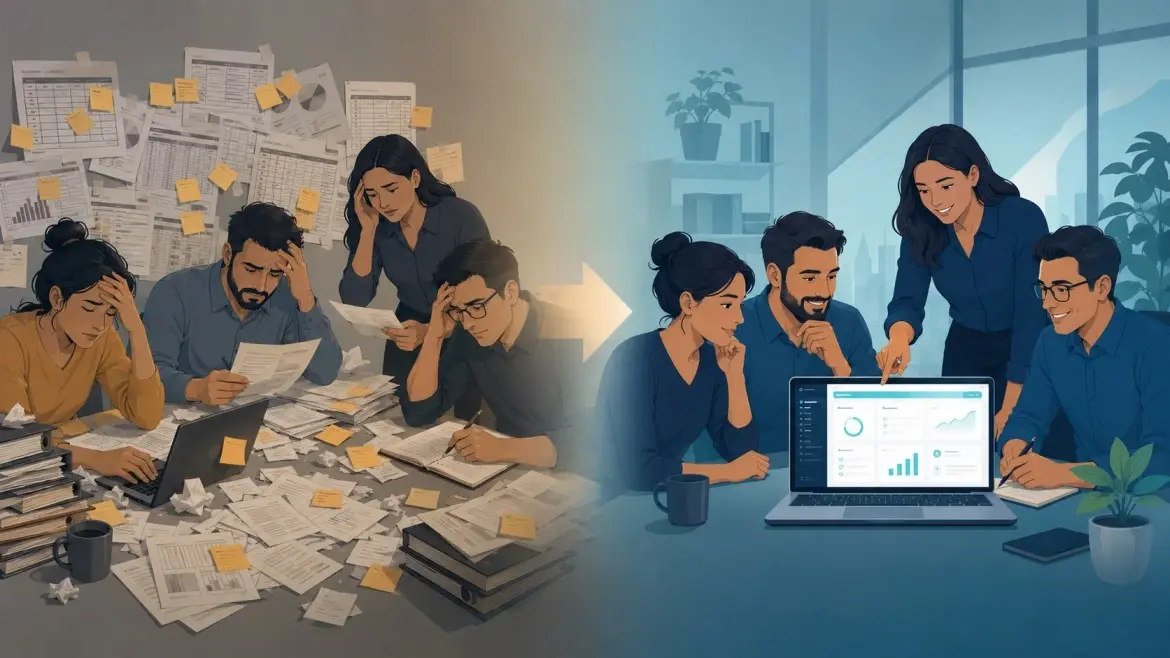
If your team is still running the business on spreadsheets, WhatsApp threads, and someone's memory of "how we've always done it," you're paying a cost you can't see on the P&L. It shows up as slower work, missed sales, and a team that's too busy patching problems to grow the business. The fix isn't more software off the shelf — it's software built around the way you already work.
The Hidden Cost of Manual Systems
Manual systems feel free because there's no invoice for them. But every process that lives in someone's head, a shared spreadsheet, or a chain of messages has a real cost. It just shows up later, and in places you don't expect.
1. Declining Productivity
Every manual handoff is a place where work stalls. Someone has to remember to update the sheet. Someone has to chase the update. Someone has to reconcile two versions that don't match. None of this is anyone's fault — it's what happens when a growing company runs on tools that weren't built for it. The bigger the team gets, the more these small delays stack up into real lost hours every week.
2. A Shrinking Ability to Expand Into New Markets
Manual processes are usually tuned to one specific way of working — one market, one currency, one set of rules. The moment you want to expand into a new city, country, or customer segment, you find out how much of your operation was held together by one person's tribal knowledge. Systems that can't flex make expansion slower and riskier than it needs to be.
3. A Direct Hit to Sales
When operations are slow, sales feels it first. Quotes take longer to prepare. Orders take longer to confirm. Support tickets pile up because nobody has a single source of truth. Customers don't wait around for internal admin to catch up — they go to whoever responds faster. Manual systems don't just cost you time; they cost you deals.
4. A Team Stuck Fighting Fires Instead of Building
Maybe the most expensive cost is where your best people's attention goes. Instead of improving the product, refining the pitch, or talking to customers, your team spends its time reconciling data, fixing errors, and answering "wait, which version is correct?" A business run on manual systems spends its energy maintaining itself instead of growing.
Why Off-the-Shelf Software Isn't Always the Answer
The natural next step feels obvious: buy software. But most off-the-shelf tools have a catch nobody mentions in the sales pitch — you don't get to keep your process. You adopt theirs.
Generic software is built for the average customer, not for you. So your team ends up doing double work: forcing your actual workflow into a tool that assumes a different one, then building workarounds for everything that doesn't fit. You didn't remove the manual work. You just moved it into a more expensive tool.
The Better Path: Software Built Around How You Already Work
Custom-built software flips this. Instead of your team adapting to the software, the software is built to match how your company already operates — your approval steps, your pricing logic, your reporting needs, your customer journey.
The result is software that requires almost no retraining. Your team doesn't have to "learn a new system" the way they do with off-the-shelf tools — because the system already looks like their job. That's the real difference: adoption isn't a project, it's just... easier than what they used to do.
This is the core of what Booma Tech builds for growing companies. We design and build software around your existing process, not the other way around, so your team can move faster on day one instead of spending months adjusting to a tool that was never built for you.
What This Looks Like in Practice
A company moving off manual systems with custom software typically sees three things change quickly:
Faster internal handoffs — approvals, updates, and data move automatically instead of manually
One source of truth — no more reconciling three versions of the same spreadsheet
Room to scale — new markets, teams, or products don't require rebuilding your operations from scratch
None of this requires your team to become technical. It requires software that was designed for the business you actually run.
How to Know It's Time to Move Off Manual Systems
A few signs it's worth the conversation:
Your team spends more time reporting on work than doing it
Sales or delivery slows down every time the business grows
Every new hire needs a long, informal explanation of "how things really work"
You've tried an off-the-shelf tool and ended up building workarounds anyway
If any of that sounds familiar, the cost of staying manual is already higher than the cost of building something that fits.
FAQ
Is custom software more expensive than off-the-shelf tools? Upfront, sometimes. Over time, it's often cheaper — you're not paying in lost productivity, workarounds, or a team relearning a process that never matched their own.
How long does it take to build custom software for a growing company? It depends on scope, but most companies start with one core process (like sales, operations, or fulfillment) and expand from there — not a full rebuild on day one.
Do we need a technical team to manage custom software? No. A good custom build is designed to be run by the team that already does the work, with the technical partner handling the engineering side.
What's the difference between off-the-shelf and custom software? Off-the-shelf software makes you adapt to its process. Custom software is built to match the process you already have.
Is this only for large companies? No — it's often most valuable for growing startups, where inefficient manual systems compound the fastest as headcount and customers increase.
The Bottom Line
Manual systems don't fail loudly. They fail quietly, one delayed handoff and one lost deal at a time. The fix isn't forcing your team into generic software — it's building software around how your company already works, so adoption is effortless and growth doesn't get stuck behind admin.
Booma Tech builds custom software for growing companies that have outgrown manual systems. If your team is spending more time managing the business than growing it, talk to us about what a custom build could look like for you.
Keep Reading
Non-technical founder building a tech startup? Learn why a fractional CTO beats hiring full-time, what they actually do, and how to pick one.